WhatsApp Marketing
In India, the UAE, and most markets outside the US, WhatsApp isn't a backup channel — it's where a business gets found, trusted, and followed up with. Here's how WhatsApp Business marketing actually works, and how we run it as a full acquisition channel, not an afterthought bolted onto email.
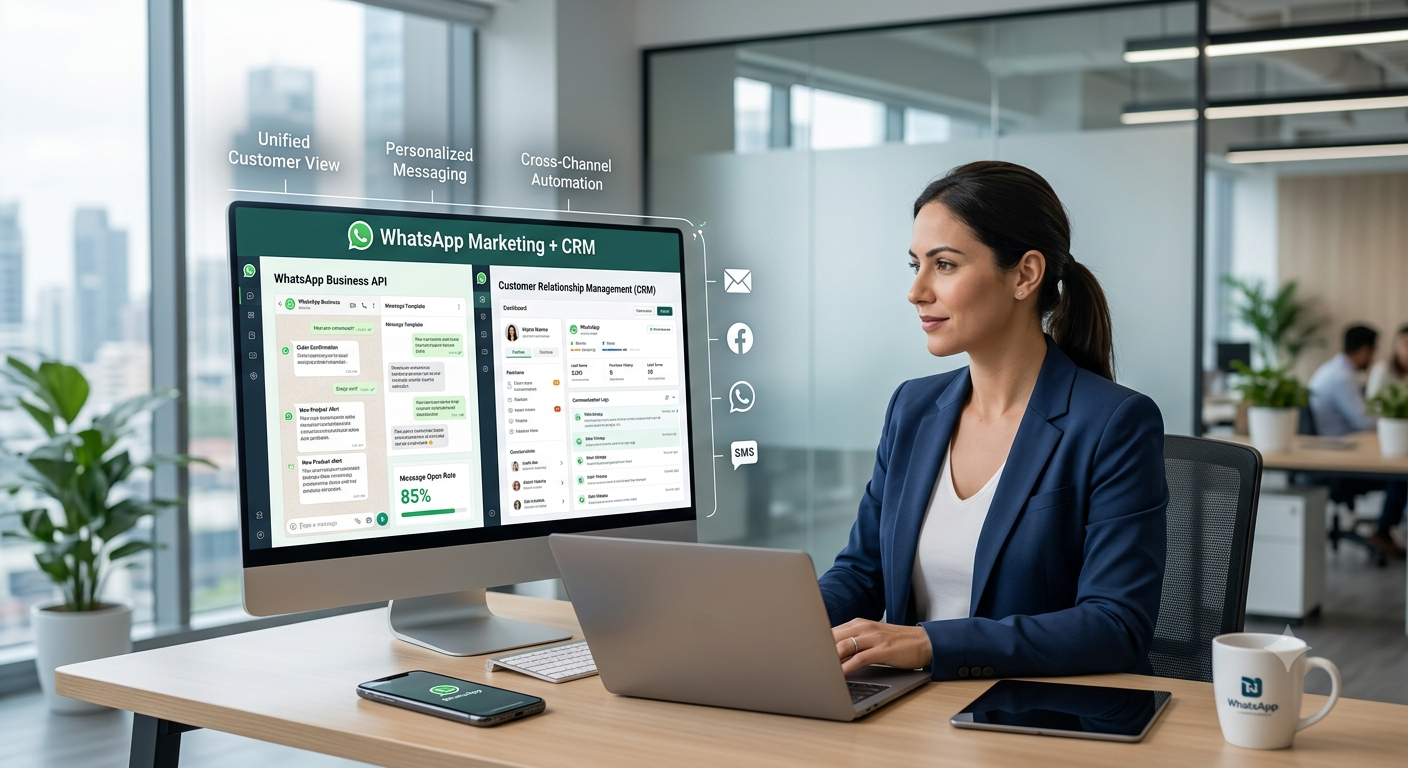
WhatsApp Business marketing covers a few distinct things people often lump together: the WhatsApp Business API (the formal, verified way a company sends and receives messages at scale), catalog messaging (browsable product listings sent directly in-chat), broadcast campaigns (permission-based messages to existing contacts), and automated response flows (instant replies to new enquiries).
Each does a different job — a catalog message drives a purchase decision, a broadcast re-engages an existing contact, an automated flow captures a new lead the moment it arrives.
Read rates on WhatsApp are dramatically higher than email in every market, but the channel plays a genuinely different role depending on where your buyers are. In India, the UAE, and much of the rest of the world, WhatsApp is often the default way a business communicates with customers — not a secondary option.
In the US and UK, it tends to function more as a fast-response layer for people who already prefer messaging over calls or forms. Both are valid strategies; they just call for different campaign structures, which is where most WhatsApp marketing goes wrong — treating every market as if it should be run the same way.
A full WhatsApp channel — not just replies.
- WhatsApp Business API setup and verification
- Catalog and product messaging — browsable listings sent directly in-chat
- Broadcast campaigns — segmented, permission-based messaging to existing contacts and leads
- Automated response flows — every new enquiry answered within 60 seconds, in-chat
- Click-to-WhatsApp ad campaigns from Meta, driving straight into a conversation instead of a landing page
Questions we get often
The app is a free, single-device tool for small businesses managing conversations manually. The API is built for scale — it supports automation, integrates with a CRM, and requires formal verification through Meta. Most businesses running real campaigns need the API, not the app.
Drafts and tests message variants for broadcasts, flags conversations that need a human handoff, routes enquiries into the CRM instantly.
What's actually sent to a customer list, what claims are made in a catalog message, when a conversation needs a real person instead of an automated flow.
Every WhatsApp enquiry — whether from an ad, a broadcast, or an organic contact — routes into the same CRM and lead pipeline as every other channel, so cost per lead stays comparable across Google Ads, Meta, and WhatsApp side by side. See CRM & Automation →
Four steps. AI speed. Human judgment.
The same repeatable system runs behind every channel we manage — so growth is a process, not a guess.
- 01
Get Found
Rank on Google and be the answer when buyers ask ChatGPT.
AI maps what your buyers search.
- 02
Get Clicked
AI-tested ads across Google, YouTube, Meta, banners, and Gmail — approved by senior marketers.
AI produces video, banner, and static creative; humans pick what runs.
- 03
Get Leads
Landing pages and creative that turn clicks into enquiries, not just traffic — every page tested for what actually gets visitors to enquire. And we identify the companies showing buying intent even when they browse without filling out a form.
AI drafts pages and creative; senior marketers approve.
- 04
Convert Leads
Every lead answered in 60 seconds and booked onto your calendar.
AI replies in 60 seconds; meetings land on your calendar.
Find out what buyers see when they search for what you sell.
No pitch deck. If we're not a fit, you still keep the plan.